I’ve spent years studying how metal joins hold up under pressure, heat, and real-world use. When projects demand performance beyond what welding or mechanical fasteners can reliably deliver, I turn to techniques de brasure forte pour métaux as a pragmatic, high-value solution. In this article I’ll walk you through the practical choices—how to pick rods, manage temperatures, and stay safe—so you can design and execute metal assemblies that meet industrial standards without guessing.
Why brasure forte? When and why I choose it
Brasure forte (brazing) sits between soldering and welding: it uses a filler metal that melts above 450°C but below base metal melting points, creating capillary-bonded joints with excellent mechanical strength and leak-tightness. I opt for brazing when I need:
High joint strength with minimal base-metal distortionJoining dissimilar metals (e.g., copper to stainless steel)Thin parts or assemblies where welding heat would damage componentsClean, leak-tight joints for HVAC, hydraulics, or aerospace subsystemsIndustry data confirms brazing remains essential: brazing and soldering alloys represent a sizable portion of the metal-joining market, with brazing increasingly used in manufacturing sectors focused on miniaturization and heat-sensitive assemblies (see ASM and AWS links below).
Types of brazing and common filler metals
Understanding filler chemistry and melting ranges is the backbone of good brazing practice. Here are the main families I use and why:
Silver-based alloys — Melting range roughly 600–900°C. Excellent for copper, brass, stainless steel; strong, good wetting, common in HVAC and jewelry. Popular compositions include Ag-Cu-Zn and Ag-Cu-Pd.Copper-phosphorus (self-fluxing) — Melting range around 700–800°C. Ideal for copper-to-copper; phosphorus acts as a flux on copper but is not suitable with ferrous metals or stainless without flux.Brazing bronzes (Cu-Zn, Cu-Sn) — Melting ~700–900°C. Cost-effective, good for steel and copper assemblies.Nickel-based brazing alloys — Higher-temperature alloys (900–1200°C); used when oxidation resistance and strength at elevated temperature are required, e.g., in aerospace or gas turbines.Aluminum brazing alloys — Special flux and vacuum/furnace processes; used in heat exchangers.Choosing the right rod: a decision framework I use
When picking a filler rod I follow a pragmatic checklist:
Base metals involved — Some fillers bond better to certain substrates. Silver is versatile; copper-phosphorus is excellent for copper only.Service temperature and loads — Choose tensile-strength-rated alloys for structural loads (nickel-based for high temp).Corrosion environment — Consider galvanic compatibility and corrosion resistance.Joint clearance and capillarity — Thinner gaps favor lower-viscosity silver alloys; thicker gaps may need bulkier bronzes.Available heat source and process — Hand torch, induction, furnace, or vacuum brazing each restrict filler selection.Practical example: for a copper pipe to brass fitting in HVAC, I typically choose an Ag-Cu-Zn silver alloy (e.g., AWS BAg-5) because of its low melting range, ease of flow, and good corrosion resistance. For joining dissimilar metals like stainless to carbon steel in a high-temp application, I might choose a nickel-based brazing filler for its higher melting range and better mechanical properties at elevated temperature.
Temperatures of work: what I monitor and why
Temperature control is critical. Each filler has a specified brazing temperature range; I always target slightly above the alloy’s liquidus to ensure full flow without overheating the base metals. Key temperature notes I follow:
Measure in-joint temperature, not just torch flame—use thermocouples or IR pyrometers.Preheat large assemblies to reduce thermal gradients and avoid quenching stress.Avoid exceeding the base metal’s tempering temperature (for heat-treated steels) to preserve mechanical properties.Typical ranges:Silver alloys: 620–860°CCopper-phosphorus: 700–820°CBronze: 700–900°CNickel alloys: 900–1200°CStatistical note: achieving uniform joint temperature within ±10°C of target significantly increases joint strength and reduces porosity. In production, process capability (Cpk) for brazing temperature control should aim for >=1.33 for consistent parts.
Flux, atmosphere, and cleanliness
Flux and atmosphere management determines whether the filler wets properly. My rules of thumb:
Flux selection — Use flux that matches filler and substrate (borax-based fluxes for many silver alloys; special fluxes for aluminum).Active atmosphere — For critical or cosmetic joints, vacuum or controlled inert (nitrogen, argon) atmospheres prevent oxidation and eliminate flux residues.Cleanliness — Oils, paint, oxides kill wetting. I always degrease and mechanically remove heavy oxides before brazing.Safety and PPE: what I never compromise on
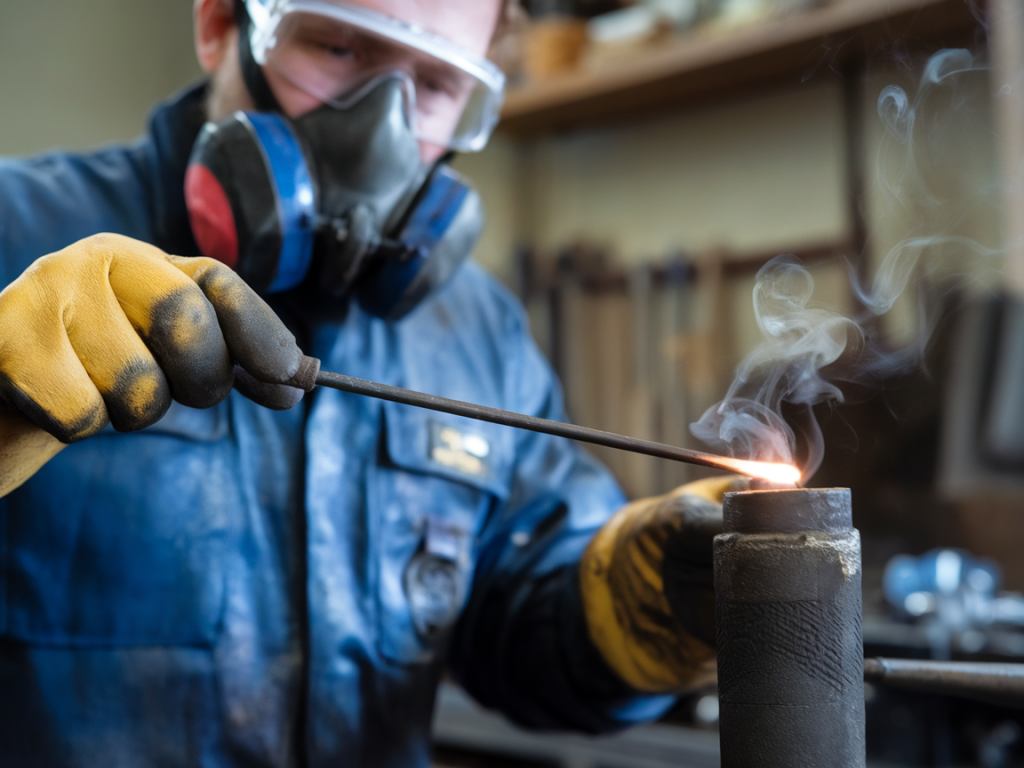
Brazing involves high heat, bright flames, fumes, and potential UV/IR exposure. My non-negotiables:
Proper ventilation or local fume extraction—silver alloys and fluxes produce fumes with respiratory hazards.Heat-resistant gloves, face shield/goggles rated for IR/UV, and flame-resistant clothing.Safe handling of flux powders (dust masks) and storage of rods (avoid moisture for hygroscopic alloys).Fire safety: remove combustible materials, have a Class B extinguisher nearby, and follow hot-work permitting for industrial sites.Process methods I use and recommended best practices
Common brazing processes I deploy depending on scale and requirements:
Torch brazing — Flexible for repair work and small assemblies. Watch for uneven heating and excessive flux smoke.Furnace brazing — Excellent for batch consistency and controlled atmospheres; ideal for production volumes.Induction brazing — Fast, localized heating, minimal distortion, high repeatability—great for automotive components.Vacuum brazing — Preferred for high-reliability aerospace/medical parts due to oxide-free joints.Checklist for consistent quality:
Confirm joint clearance (0.03–0.15 mm for capillary action in many silver brazes).Use flux or controlled atmosphere appropriate to filler.Ramp uniformly and hold at temperature for adequate flow time (often 10–60 seconds for torch brazing; minutes for furnace depending on assembly mass).Cool under controlled conditions to avoid thermal shock or quench-induced stress.Comparative table of common filler alloys
| Filler Type | Typical Melting Range (°C) | Typical Tensile Strength (MPa) | Best For |
| Silver (Ag-Cu-Zn) | 620–760 | 200–400 | Copper, brass, stainless; HVAC; jewelry |
| Copper-Phosphorus | 700–800 | 150–300 | Copper-to-copper, plumbing (no ferrous) |
| Bronze (Cu-Sn, Cu-Zn) | 700–900 | 150–350 | Steel, copper assemblies where cost matters |
| Nickel-based | 900–1200 | 400–700+ | High-temp, dissimilar metals, aerospace |
| Aluminum alloys (special) | 560–600 | 100–250 | Aluminum heat exchangers (requires flux/vacuum) |
Common failure modes and how I mitigate them
Even experienced operators face joint failures. These are the ones I watch for and prevent:
Poor wetting — Caused by oxides or wrong flux; solution: clean properly and use compatible flux/atmosphere.Insufficient filler — Gaps too large for capillary action; design for 0.03–0.2 mm clearances or use appropriate filler viscosity.Overheating/annealing — Damaged metallurgical properties in heat-treated steels; control peak temps and use fixtures for heat sinking.Brittle intermetallics — Particularly with some copper-phosphorus on steels; choose compatible filler or use diffusion barriers.Standards, specs and reliable references I consult
For professional projects I always cross-check against standards and technical sources. Useful references include:
American Welding Society (AWS) brazing resources — practical specs and classification tables.ASM International — metallurgical guidance on filler metals and joint metallurgy.McMaster-Carr — practical product data for rods, fluxes, and equipment.ISO standards — where international compliance is required (e.g., ISO 17672 for brazing).Practical tips for designers and procurement
When specifying brazed assemblies, I recommend designers and buyers:
Specify filler alloy (AWS designation) rather than generic “silver brazing rod.”Include brazing temperature limits and pre/post-heat requirements in drawings.Require process documentation: brazing procedure spec (BPS), operator qualification, and inspection criteria (visual, leak test, or metallography for critical parts).Consider production method: furnace or vacuum brazing may add capital expense but lower per-part labor and increase repeatability.Quick reference stats
Typical tensile strength improvement over soldering: brazed joints often exhibit up to 3–10x the strength of soft-soldered joints depending on filler.Capillary gap: optimal 0.03–0.15 mm for most silver brazes; production tolerance bands should be tighter than ±0.02 mm where possible.Time-to-braze (torch): small joints often wet in 10–60 seconds at correct temp; larger assemblies require extended soak in furnaces.Where to learn more and next steps I recommend
If you’re scaling from prototypes to production, start with process trials: document joint geometry, filler selection, heating profile, and inspection results. Consider partnering with a brazing house or lab for initial qualification and to validate material compatibility. The links above to AWS, ASM, and McMaster-Carr are my go-to starting points for materials and specs.
Sources and further reading:
AWS brazing resourcesASM InternationalMcMaster-Carr product and material dataISO brazing standards