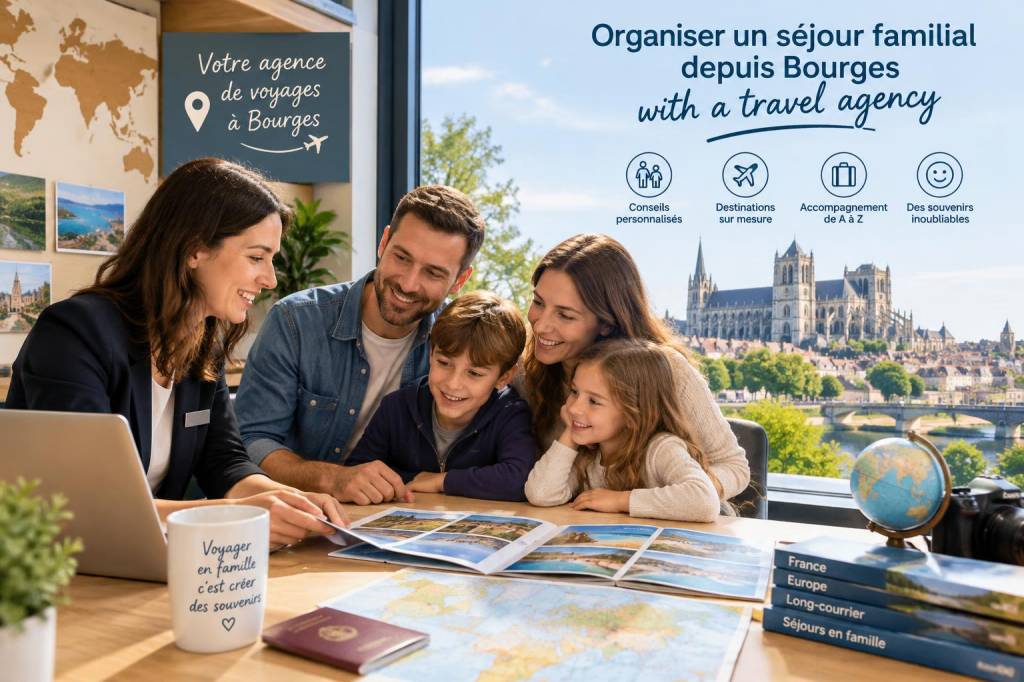
When I plan family travel from Bourges, I think like a project manager first and a traveler second. A family trip is never just a booking exercise: it is a coordination problem, a budget exercise, a risk check, and a comfort decision all at once. That is exactly why organiser un séjour familial depuis Bourges can become much easier with a travel agency that knows how to turn family needs into a workable plan.
For me, a strong travel partner matters even more when several people are involved. Children need pace, parents need visibility on cost, and everyone needs a trip that feels balanced rather than improvised. A travel agency can simplify that process by comparing transport, accommodation, schedules, and activity options in a single workflow. It is not only about convenience; it is about making a family trip more reliable, more coherent, and often more economical than a series of disconnected bookings.
Why a travel agency changes the family planning process
I see family travel planning as a management challenge with moving parts. A travel agency brings structure to that challenge. Instead of me spending hours comparing dozens of websites, I can rely on one advisor to assemble a realistic plan that fits ages, dates, sleeping needs, and travel times.
A good agency usually adds value in four practical ways:
- Time savings: one briefing can replace many hours of searching.
- Better coordination: transport, lodging, and activities are aligned.
- Lower stress: I get fewer surprises and clearer cancellation rules.
- Stronger fit: the trip can be adapted to children, grandparents, or mixed-age groups.
This matters because family travel is not a niche concern. According to UN Tourism, international tourism recovered strongly after the pandemic, and family-oriented travel remains one of the most resilient segments in many markets. Eurostat also shows that a large share of European households still prioritize short breaks and domestic travel patterns, which means flexibility and budgeting remain central concerns for families. In my experience, those realities make professional planning especially useful.
What I expect from an agency when I leave from Bourges
When I organize a trip from Bourges, I want the agency to think locally and nationally at once. Bourges is not a large airport hub, so transport planning has to be smart. That can mean rail connections, transfers to a departure airport, or routes that combine train and flight in a smooth sequence. I prefer agencies that do not treat transport as an afterthought.
I also expect the advisor to ask very concrete questions:
- How old are the children?
- Do we need one room, two rooms, or an apartment?
- Is the family comfortable with a long drive or rail transfer?
- Do we want full-board, half-board, or self-catering?
- Are we prioritizing beach time, culture, nature, or theme parks?
These questions may sound simple, but they are what separate a generic package from a family trip that actually works. I value agencies that translate those answers into a real plan rather than a brochure-style suggestion.
Budget, value, and what family travel really costs
One reason I use an agency is that family budgets can be deceptive. A price that looks attractive online can become expensive once luggage, airport transfers, breakfast, child supplements, resort fees, and activity costs are added. I prefer to compare total trip value, not only headline price.
Here is a practical comparison I would use when evaluating options:
| Trip element | Independent booking | Agency planning | My note |
|---|---|---|---|
| Transport | Separate search for rail, flight, and transfer | Single coordinated itinerary | Less risk of missed connections |
| Accommodation | Many filters, many policies | Shortlist matched to family size | Room layout matters more than price alone |
| Activities | Book each item alone | Package can bundle experiences | Useful for saving planning time |
| Support | Contact each supplier separately | One point of contact | Very useful if plans change |
According to OECD data on household spending patterns, travel and leisure decisions are strongly influenced by perceived value and uncertainty. That matches my own experience: families are not only buying nights in a hotel, they are buying peace of mind. When I weigh options, I ask whether the package reduces hidden costs and reduces planning risk.
Family needs I always put first
I never start with destinations. I start with family needs. That mindset usually produces better results. Before choosing a place, I define a few non-negotiables.
- Sleep quality: enough beds, quiet rooms, and practical layouts.
- Meal rhythm: access to flexible meal times or kitchen facilities.
- Pace: enough free time so the trip does not feel exhausting.
- Mobility: easy transfers for strollers, luggage, and tired children.
- Backup options: indoor activities in case of rain or fatigue.
For younger children, I usually favor destinations with short travel times and simple logistics. For teenagers, I prefer destinations with more autonomy, Wi-Fi, outdoor activities, and varied food options. For multigenerational travel, I focus on accessibility, medical proximity, and comfortable pacing. A travel agency can usually adapt the proposal to all of these factors much faster than I could do alone.
Destinations that work well for family departures from Bourges
From Bourges, I think in terms of reachability rather than prestige. A family destination is successful when it feels easy, not when it sounds impressive. Depending on the season and budget, I would consider several types of trips.
- French coast trips: simple logistics, predictable transport, and family-friendly beaches.
- Mountain stays: strong value for active families and nature-focused breaks.
- City breaks: ideal for older children if museums, parks, and food markets are part of the plan.
- Club resorts: useful when I want activities, meals, and childcare in one place.
- Cross-border trips: good for families who want a change of scenery without a long-haul flight.
I also like destinations that reduce friction. If a resort has kids’ clubs, multiple meal slots, and easy transfers, that can be more valuable than a “dream” destination with complex logistics. The best family trip is often the one that runs smoothly from departure to return.
What I ask before I confirm a booking
I have learned to ask direct questions before I commit. These questions save time and prevent disappointment later.
- What is included in the price?
- Are airport transfers or station transfers included?
- What is the real policy for child pricing?
- Are rooms interconnected or split across floors?
- What happens if train times or flight times change?
- Is there support during the trip, or only before departure?
- Are excursions age-appropriate and weather-flexible?
These questions help me compare agencies on substance rather than presentation. I also value written confirmations. Email is not glamorous, but it creates clarity on inclusions, payment deadlines, and cancellation terms.
Why family travel and management thinking fit together
On this site, I usually think in terms of business and management, and family travel fits that lens very well. A trip is a temporary project with a deadline, a budget, a service chain, and customer expectations. If one element fails, the whole experience suffers. That is why I appreciate agencies that think like operations teams.
In practice, that means:
- clear planning milestones
- transparent cost breakdowns
- contingency planning for delays
- vendor coordination across transport and lodging
- family-centered service design
This approach is especially useful when I am comparing several options at once. A family trip is not only about emotion; it is also about process quality. The more structured the process, the easier it is to protect both budget and enjoyment.
Useful sources I trust when I compare travel options
When I want to validate a decision, I usually cross-check a few external sources rather than relying on a single sales page. These are the kinds of references I find useful:
- UN Tourism for broad travel demand trends and market recovery data.
- OECD for household spending context and consumer behavior patterns.
- Eurostat for European travel and leisure statistics.
- French public transport providers for route reliability and transfer planning.
That habit helps me separate marketing language from practical reality. It also helps me ask better questions to the agency, which usually leads to better proposals.
When a travel agency is especially useful
I find agency support most valuable in a few situations:
- when I have limited time to compare offers
- when several age groups are traveling together
- when travel dates are fixed and flexibility is low
- when I need help combining rail, flight, or transfers
- when I want one accountable contact if plans change
For a simple overnight stay, I may book alone. For a real family holiday, I often prefer expert support. That difference matters because complexity rises quickly when children, baggage, schedules, and budgets all have to work together.