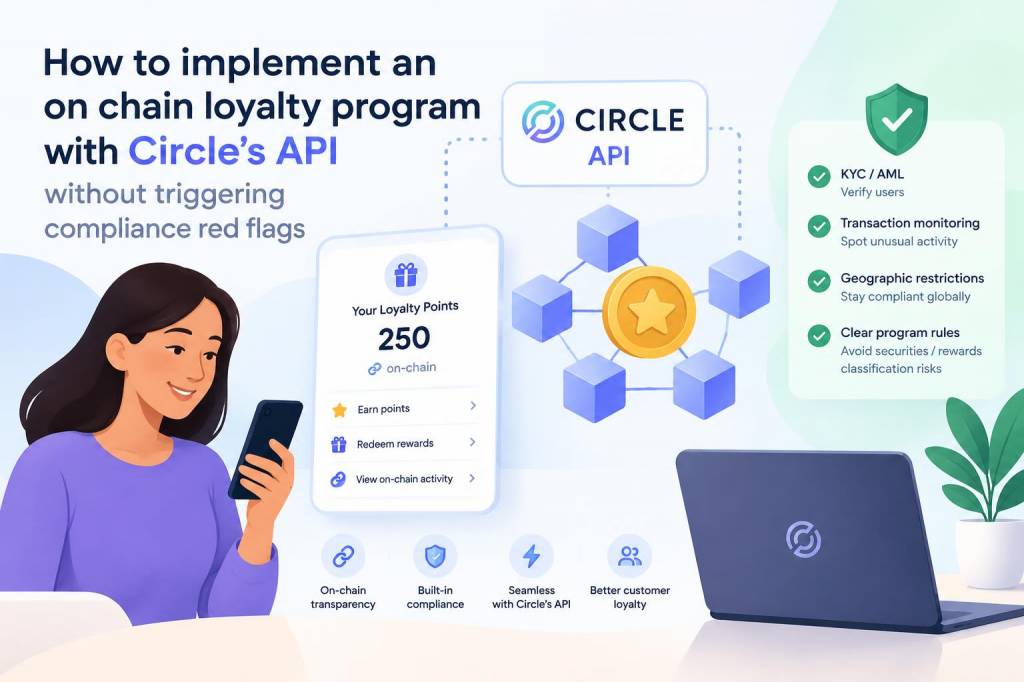
I’ve been building and advising on loyalty programs for years, and the idea of bringing them on-chain is irresistible: transparency, instant settlement, programmable rewards. But as soon as you start dealing with tokenized value—especially stablecoins like USDC—you’re walking into a complex compliance landscape. In this piece I’ll walk you through how I would implement an on-chain loyalty program using Circle’s APIs while minimizing the risk of triggering compliance red flags. I’ll keep this practical and candid: think product, architecture, and the processes that make compliance part of the design rather than an afterthought.
Why use Circle and USDC for loyalty?
I favor Circle and USDC because they combine broad network support, clear documentation, and operational controls that businesses need. Using a regulated stablecoin reduces volatility risk for users and makes redemption straightforward. Circle’s APIs also provide account and transaction controls, webhooks, and compliance tooling that you can integrate into your backend systems.
Design principles I follow
Separation of concerns: Keep the loyalty accounting layer (points, tiers, rules) separate from the tokenization layer (USDC minting/redemption). This reduces attack surface and simplifies compliance reviews.Least privilege: Give systems and keys the minimum permissions needed—Circle account separation, scoped API keys, and role-based access in your own services.Transparency and auditability: Ensure every tokenized movement maps back to a business event in your ledger with immutable references (transaction IDs, order IDs).Onboarding and KYC where needed: Know when to require KYC for users and merchants, and build frictionless, staged flows so you don’t over-collect data unnecessarily.High-level architecture I recommend
Here’s a simplified stack that I’ve found useful:
Front-end / Mobile app: User interactions, reward earning, redemptions. Minimal exposure to private keys—custodial wallets are often preferable.Loyalty service: Your business logic for points, expiry, tiers, and conversion rules. This service stores the mapping between points and on-chain assets.Tokenization service: Integrates with Circle’s APIs to mint/redeem USDC for loyalty redemptions or merchant payouts. This layer enforces spend limits and compliance checks before requesting token movements.Compliance & monitoring: AML rules, sanctions screening, transaction monitoring, and webhooks. Connects to both Circle and your internal analytics/alerting.On-chain smart contracts (optional): If you issue an ERC-20 loyalty token, keep it simple—use transfer restrictions and allowlists to prevent misuse.Practical steps to implement without triggering red flags
1) Define the product flow precisely: Are you awarding points that can be converted to USDC? Or are you directly crediting USDC to user wallets? I prefer awarding internal points and only tokenizing at redemption. That minimizes the number of on-chain value flows and reduces the number of users requiring KYC upfront.2) Use Circle’s business account model and scoped API keys: Create separate Circle accounts or sub-accounts for production, escrow, and merchant settlement. Use scoped API keys and rotate them regularly. Limit API capabilities for your tokenization microservice.3) Implement staged KYC: Allow users to earn points without KYC, but require identity verification for redemption above certain thresholds. This staged approach follows the “Know-When” principle—KYC when control over monetary value is transferred.4) Set thresholds and limits: Hard caps on daily/monthly redemptions, per-user limits, and velocity checks. These controls reduce structuring risk and lower the chance of suspicious pattern generation.5) Sanctions & PEP screening: Integrate sanctions screening for merchant onboarding and for users at redemption. Circle performs sanctions screening, but you should run pre-authorization checks in your flow to block high-risk actions before calling token APIs.6) Maintain rich metadata and mapping: Every Circle payment or transfer should include metadata: merchant ID, user internal ID, original earning event reference, IP geolocation, and reason codes. Rich metadata aids investigations and reduces false positives in monitoring systems.7) Use webhooks and reconcile in real time: Subscribe to Circle webhooks for transaction events and reconcile on-chain events with your loyalty ledger. Quick reconciliation helps surface anomalous behavior early.8) Consider custodial wallets and on-chain restrictions: If you want a fully on-chain loyalty token, implement transfer restrictions (e.g., only allow transfers to addresses that completed KYC or to an approved merchant list). If you use USDC, you can control movements by holding funds in a centralized operational wallet and making on-chain disbursements via controlled processes.Smart contract and on-chain controls
If you deploy a loyalty token or use smart contracts to manage redemptions, keep them auditable and simple. I prefer:
Allowlist-based transfers: The token contract only permits transfers involving addresses on an allowlist maintained by the backend. That let’s you enforce that only verified users or merchants receive funds.Timelocks and rate limits: Contracts that enforce per-address transfer limits and global caps to reduce the chance of mass-exfiltration.Upgradability with governance: If you anticipate product iteration, use an upgradable pattern with multi-sig governance to control upgrades and reduce single-point-of-failure risk.Operational compliance
Technical controls aren’t enough. Here’s what I run in operations:
Transaction monitoring rules: Build rules for large redemptions, sudden spikes in redemptions, high velocity across addresses, or inconsistent metadata. Tune them to reduce noise.Case management: Integrate alerts with a case management system and assign investigative SOPs so alerts are actionable.Merchant due diligence: Onboard merchants with business verification, and monitor merchant settlements for anomalous behavior.Data retention and privacy: Store what you need for investigations and compliance but minimize personal data exposure. Keep access logs and protect PII.Using Circle’s API features effectively
Circle provides endpoints for accounts, payments, and webhooks that are useful to the loyalty flow:
Accounts & balances: Maintain segregated balances for operations and ensure you reconcile balances nightly.Payments API: Use it to send USDC to merchant wallets when users redeem. Always include contextual metadata with each payment.Webhooks: Subscribe to payment and webhook events for real-time reconciliation and alerting.Sandbox and testing: Use Circle’s sandbox extensively to simulate redemptions and edge cases, including failure modes and webhook replay scenarios.How I tune the user experience to avoid unnecessary friction
Compliance shouldn’t be a poor user experience. I aim for a frictionless journey that still meets regulatory needs:
Provide clear thresholds: Tell users upfront when KYC will be required and why. Transparency reduces support load and builds trust.Offer fast KYC options: Integrate with identity providers that provide quick verification and re-try flows.Graceful downgrade paths: If a user can’t complete KYC, allow non-monetary redemptions like vouchers or discounts to retain value without the AML burden.Engage legal and regulators early
I always recommend getting counsel involved early and, where appropriate, engaging regulators or your banking partners. Show them the flow: isolated tokenization, thresholds, AML tooling, and data retention. This proactive approach often prevents surprises later.
What to monitor continuously
Operational metrics I watch closely:
Redemption velocity per user and merchantVolume of on-chain USDC flows vs. internal points issuedRatio of KYC conversions at redemption thresholdsFalse positive rate on alerts and SLA for investigationsIf you follow these principles—separating internal points from tokenized value, staging KYC, enforcing limits and allowlists, instrumenting metadata, and leveraging Circle’s APIs for controlled token movement—you can deliver an on-chain loyalty program that’s innovative and pragmatic, while avoiding many common compliance pitfalls. For teams building this, start with proof-of-concept flows in Circle’s sandbox, codify your AML rules as executable checks, and iterate with legal input. If you want, I can draft an example flow diagram or a checklist tailored to your business model.