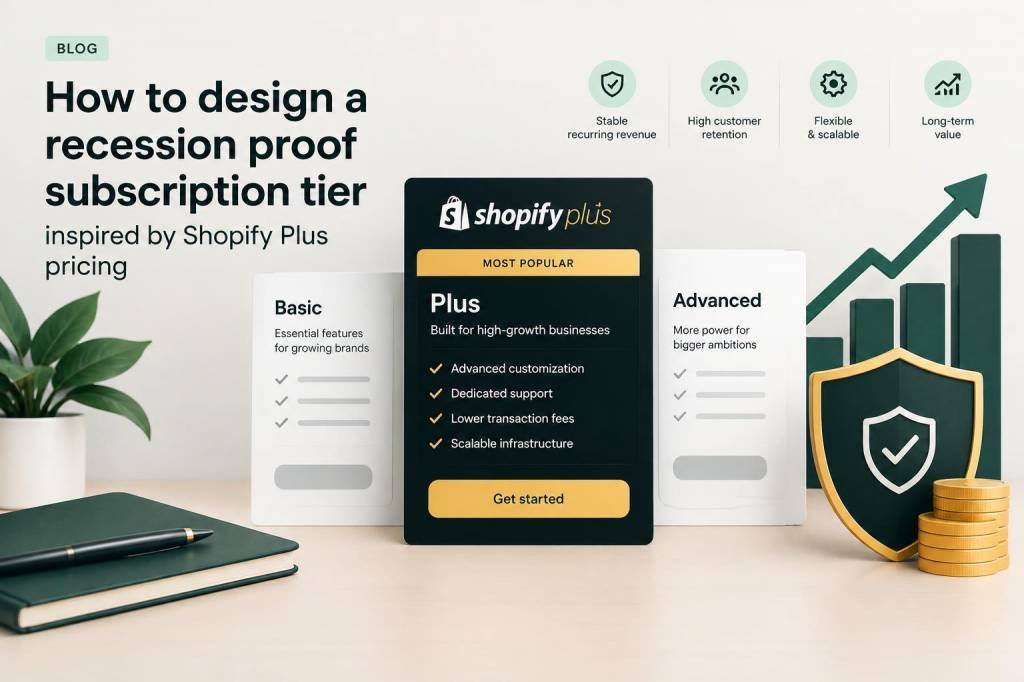
When I first studied Shopify Plus pricing, what struck me wasn't just the sticker price — it was the way Shopify built a sense of predictability, enterprise-level trust, and clear upgrade paths for merchants. Designing a recession-proof subscription tier doesn’t mean copying a competitor; it means extracting the principles that make enterprise pricing resilient and adapting them to your product, market, and customer's emotional needs during economic uncertainty.
Start with the customer jobs-to-be-done, not the feature list
During downturns, buyers are ruthless: they prioritize ROI, risk reduction, and scalability. I always begin by mapping customer jobs-to-be-done for the target segment you want this tier to serve. For a Shopify Plus-inspired tier, those jobs might include:
- Reducing operational friction for high-volume merchants
- Minimizing downtime and technical risk during peak periods
- Enabling faster time-to-value through expert onboarding
- Providing predictable billing for finance teams
When you anchor the tier to these jobs, every feature and pricing element becomes a sales argument: it’s not “you get dedicated support,” it’s “we prevent $X of lost revenue during your busiest day.”
Choose a value metric that scales with customers’ revenue and risk
Shopify Plus famously ties pricing to a revenue-linked model for some merchants (or fixed fees for others). I recommend selecting a value metric that scales with customer success and is defensible in negotiations. Options I’ve used successfully include:
- Percentage of revenue processed via the platform (aligns incentives)
- Number of active buyers / transactions (predictable for finance teams)
- Seats or locations for multi-site operations
- Base fee + usage layer (capable of smoothing spikes)
Why this matters: In recessions, customers want to avoid fixed overhead but accept variable costs tied to performance. A hybrid model—a conservative base + small variable component—gives you stable revenue while being perceived as fair.
Design tier features that speak directly to recession concerns
Features that seem luxurious in growth periods become essential during downturns. For a recession-proof enterprise tier, prioritize:
- Guaranteed uptime & SLAs — offer credits and clear remediation paths
- Dedicated onboarding and migration — reduce transition risk
- Strategic success reviews — quarterly ROI audits showing cost-savings
- Priority support & access to experts — shorten resolution times for revenue-impacting issues
- Advanced analytics & forecasting — help customers cut costs and reallocate spend
- Flexible contract terms — allow scaling down/up with minimal friction
These features reduce perceived risk and shift the conversation from cost to protection and optimization.
Offer flexible commercial terms that lower the short-term barrier
In a recession, multi-year contracts are harder to sell. I recommend structuring commercial terms to be agile while protecting lifetime value:
- Quarterly commitments with an annual discount — get predictable revenue while reducing buyer hesitation
- Performance-based rebates — link part of the fee to agreed KPIs
- Exit or pause clauses — build confidence with “safety-net” terms for a limited period
- Migration credits — if a customer moves from a lower tier, offer credits for onboarding to justify the step-up
These levers make the tier accessible without commoditizing it.
Package onboarding and professional services as ROI accelerators
One of Shopify Plus’s strengths is the inclusion of concierge services and launch support. I always embed measurable professional services into the enterprise tier, not as a bolt-on but as a conversion tool:
- Fast-track migrations with guaranteed go-live timelines
- Custom integrations that unlock automation and reduce headcount needs
- Training credits to upskill internal teams and minimize external spend
When you price these as part of the tier, customers see the immediate payback: fewer contractors, quicker launches, and reduced risk.
Use transparent, referenceable pricing with anchor tiers
Psychology matters. I use a three-tier anchoring strategy: Base, Pro, and Enterprise (the recession-proof tier sits at Enterprise). The middle tier acts as the pragmatic choice, while the top tier becomes the obvious fit for high-risk, high-value customers. Make pricing lines clear and show what incremental value each level adds.
| Tier | Target | Example Pricing | Key Benefits |
|---|---|---|---|
| Base | SMBs | $99/mo | Core features, community support |
| Pro | Growing merchants | $799/mo | Advanced features, analytics, SLA 99.9% |
| Enterprise | High-volume, risk-sensitive | $2,500+/mo or 0.5% revenue | Dedicated success, 99.99% SLA, migration, forecasting |
Numbers above are illustrative; what matters is the ratio between tiers and the clarity of value uplift.
Build predictable churn defenses into the offering
Recession-proofing is as much about preventing churn as acquiring new customers. I invest in:
- Early-warning analytics that flag accounts at risk (use product usage, support ticket volume, and revenue trends)
- Prescriptive retention playbooks — automatic outreach + executive-safe-harbor calls
- Flexible downgrades — allow customers to step down to a lighter plan without punitive fees, with an easy path back up
These measures preserve relationships and revenue while respecting customer cash constraints.
Differentiate with partnerships and ecosystem leverage
During economic slowdowns, businesses cut costs by consolidating vendors. Make your tier the easiest consolidation point:
- Bundle best-of-breed integrations and marketplace credits
- Offer preferred partner programs for agencies and consultants
- Provide co-marketing credits to help customers grow demand without incremental marketing spend
Partnerships increase perceived value and create stickiness that’s hard to replicate.
Measure outcomes and make ROI visible
Finally, the single most persuasive tool in a recession is demonstrable ROI. Make it part of the product experience:
- Dashboard showing cost savings, revenue uplift, and avoided downtime attributable to your platform
- Quarterly business reviews where you present a customized ROI report
- Case studies framed around recessionary outcomes (cost avoidance, efficiency gains, resilience)
When buyers can point to a dollar value tied to your service, the decision becomes financial, not emotional.
Designing a recession-proof subscription tier inspired by Shopify Plus is about translating certainty, alignment, and measurable outcomes into your pricing and packaging. Anchor the tier to customer jobs, choose a defensible value metric, bake in flexibility, and make ROI unavoidable. Those levers combined will help you convert risk-averse buyers, protect revenue, and build long-term enterprise relationships even when the macro environment gets tough.