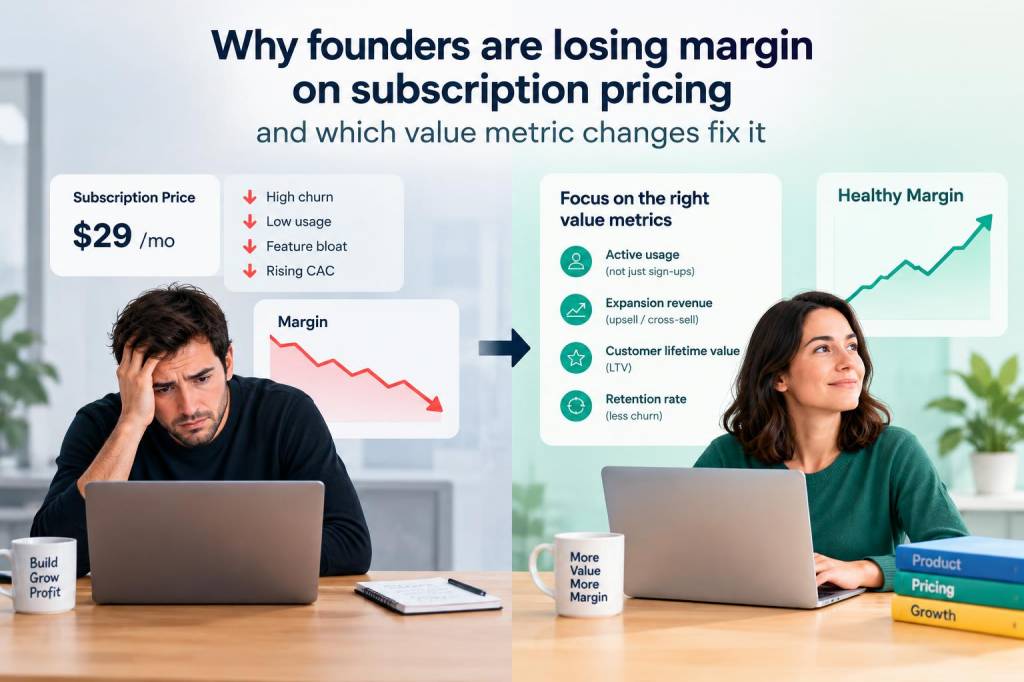
I have seen the same pattern repeat across SaaS, memberships, digital platforms, and service bundles: a subscription starts with strong growth, a clean pricing page, and healthy unit economics, then margin slowly erodes while revenue still looks respectable on paper. That is what makes subscription pricing so deceptive. It can feel stable, predictable, and efficient, yet small pricing mistakes compound month after month until acquisition costs rise faster than customer value and expansion revenue stops covering product delivery, support, and payment friction.
When I look closely at why founders lose margin, I rarely find a single dramatic failure. I usually find a mismatch between what customers pay for and what actually drives value. A company may charge by seats while customers consume usage. It may charge flat monthly fees while some clients generate ten times more support tickets than others. It may anchor price to features instead of outcomes. In each case, one group subsidizes another, and margin leakage becomes structural rather than accidental.
Why subscription margin erodes so quietly
Subscription businesses often begin with pricing that feels intuitive during the early stages. Founders pick a simple flat plan because it is easy to launch, easy to explain, and easy to sell. I understand that instinct. In the early days, simplicity matters. But once usage becomes uneven, customer segments diverge, and the product broadens, a simple fee can become a hidden discount for power users and a hidden tax on low-value users.
Margin erosion usually shows up in a few places:
- Heavy users pay too little compared with the infrastructure, bandwidth, or human support they consume.
- Low-usage customers churn because they feel overcharged for value they do not fully use.
- Discounting becomes routine during sales conversations, so list price loses meaning.
- Packaging stays static even after product behavior changes and new value drivers appear.
- Sales teams optimize for closing, not for pricing discipline or long-term margin health.
I have also noticed that founders often underestimate internal complexity costs. Every extra integration, onboarding call, premium feature request, or compliance requirement raises delivery expense. If pricing does not adapt, growth can actually reduce profitability. That is why a company can report strong top-line momentum and still feel financially fragile.
Where value and price fall out of alignment
The deepest pricing mistakes happen when founders choose the wrong value metric. A value metric is the unit that connects price to customer value. If it is chosen well, customers feel pricing is fair because it scales with benefit. If it is chosen poorly, the business either leaves money on the table or creates friction that slows adoption.
I think about value metrics in practical terms: what changes when a customer gets more value from my product? More users? More transactions? More data? More workflow automation? More seats? More revenue earned? More stores managed? The answer should shape the pricing model.
Here is where many founders go wrong:
- They price by seats even though value rises with activity or transactions.
- They price by usage even though customers care more about business outcomes.
- They price by feature tiers when different customer segments need different support burdens.
- They keep a flat subscription after usage patterns have become highly uneven.
I have found that pricing breaks down most often when the value metric is chosen for internal convenience instead of customer logic. A flat fee is easy to build, but a value-linked fee is often easier to defend, easier to expand, and easier to keep margin stable over time.
Value-metric changes that usually fix margin leakage
When a subscription business begins to lose margin, I do not immediately assume prices must rise across the board. I first ask whether the pricing unit itself is wrong. In many cases, a value-metric change solves the problem more elegantly than a blunt price increase.
| Current model | Problem | Better value metric | Result |
|---|---|---|---|
| Flat monthly fee | Light users and heavy users pay same amount | Usage bands or activity-based pricing | Revenue aligns with consumption |
| Seat-based pricing | One seat can create very different value levels | Workflow volume, projects, or transactions | Fairer scaling with customer value |
| Feature tiers | Customers buy features they do not use | Outcome-based bundles | Better perceived value and lower churn |
| Unlimited plan | Power users overload support and infrastructure | Tiered consumption limits or overage pricing | Protected margin on high-volume accounts |
One of the most effective changes I have seen is moving from seat-based pricing to usage-based pricing when product value depends on activity rather than headcount. A collaboration tool, for example, may seem logical to sell per user, but if a customer gains value through messages sent, workflows completed, or assets processed, seat count can understate value creation. In that case, usage-based pricing can improve margin and reduce resistance from customers who only need a limited number of users.
Another strong move is shifting from a single subscription to hybrid pricing. I like hybrid structures because they combine predictability and fairness. A base subscription covers access and fixed service costs, while variable pricing captures scale. This model often works well when fixed costs are meaningful but customer usage varies widely.
What I watch before changing pricing
I never treat pricing as a pure finance exercise. It is a market signal. If I change the metric carelessly, I can damage trust, sales velocity, and product adoption. Before making a change, I look for evidence in customer behavior, not just in internal margin reports.
These are the signals I look for first:
- Some customers consume far more support than others.
- High-value customers hit plan limits quickly and ask for custom terms.
- Churn is concentrated in one segment that feels overcharged.
- Expansion revenue depends on manual negotiation instead of natural product growth.
- Sales teams keep discounting because the current pricing unit feels misaligned.
When I see those signals together, I know pricing is not just a revenue issue; it is a product-market fit issue. Customers are telling us, in effect, that the current meter does not match the value experience.
How I think about a better metric
The best value metric is usually simple to understand, closely tied to value creation, and naturally expandable as customers grow. I ask three questions:
- Does this metric rise when customer value rises?
- Can customers predict it without confusion?
- Does it protect margin when usage becomes more intensive?
If the answer to all three is yes, I pay attention. If not, I keep looking. A good value metric should feel almost obvious once it is introduced. Customers should be able to say, “Yes, that makes sense. If I use more, I pay more. If I get more value, I can justify more spend.”
For example, I have seen companies in analytics, automation, and infrastructure do much better after switching from user count to data volume, processed events, or workflow runs. I have also seen companies in B2B services improve margins by charging based on stores managed, campaigns launched, or documents processed rather than a generic monthly retainer. The metric does not need to be novel. It needs to be honest.
What founders often fear, and what actually happens
Many founders worry that changing pricing will slow growth. That can happen if the change is abrupt or poorly communicated. But in my experience, a well-designed value-metric shift often does the opposite. It attracts better-fit customers, reduces pricing objections, and gives sales teams a clearer story. The key is not to surprise the market. It is to make the economic logic visible.
I also see fear around customer backlash. That fear is real, but backlash usually comes from confusion, not from change itself. If customers understand why the metric changed, and if they can see the fairness in the new structure, they are often more accepting than founders expect. I have found that many customers prefer a pricing model that mirrors their actual usage, even when that model leads to higher spend at scale.
What a margin-friendly subscription structure usually includes
When I evaluate whether a subscription structure is healthy, I want to see a few things working together:
- A clear base fee that covers fixed delivery costs.
- A value metric that rises with customer benefit.
- Natural expansion paths so account growth creates revenue growth.
- Limits or thresholds that protect margin from extreme usage.
- Packaging that matches segments instead of forcing one offer on everyone.
When those elements are in place, pricing becomes a growth engine rather than a margin leak. I think this is one of the most underrated advantages in entrepreneurship: a strong pricing model gives a company room to invest in product, hiring, and customer success without constantly fighting for every point of gross margin.
What I come back to again and again is that subscription pricing is not just about what customers can afford. It is about what they value, how they use the product, and where the business actually incurs cost. When founders align those three things, margin improves without needing aggressive sales pressure. When they do not, revenue can rise while profitability quietly slips away.