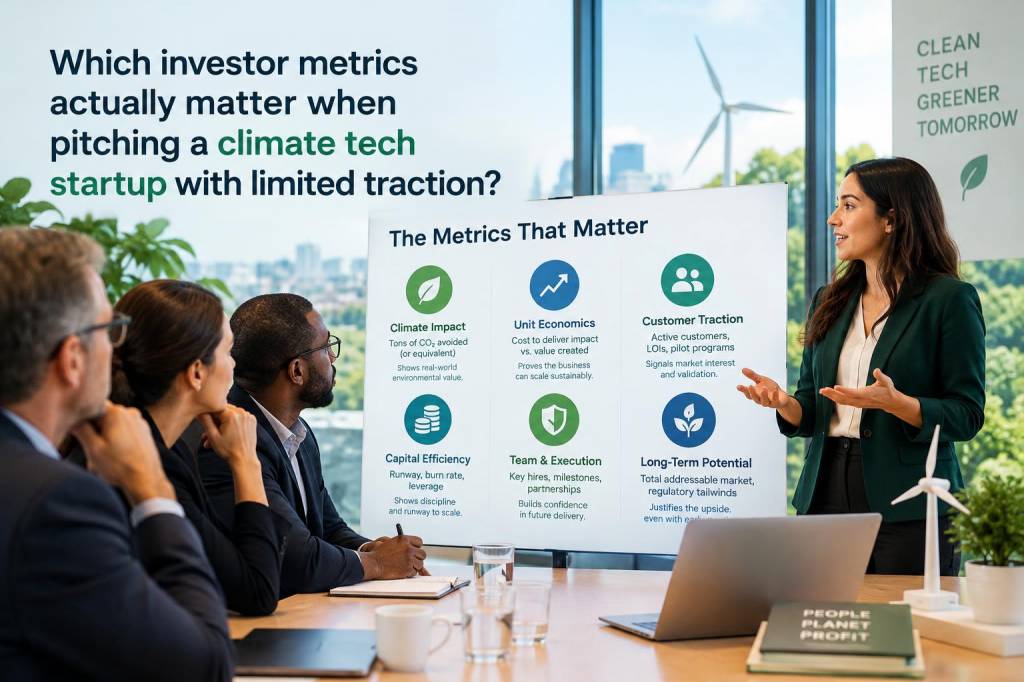
When I speak with investors about a climate tech startup that still has limited traction, I do not try to disguise the weakness. I address it directly. Early climate ventures rarely have clean, predictable growth curves. They often face long sales cycles, hardware complexity, policy dependence, or infrastructure constraints that make traction look slower than it is. What matters is not pretending those challenges do not exist. What matters is showing which metrics actually prove progress in a business that is still too early for vanity numbers to tell a useful story.
I have learned that investors do not all ask for the same proof. Some want evidence of market pull. Some want technical credibility. Some want signs that the business can survive capital intensity long enough to become efficient. When traction is limited, I focus on metrics that reduce uncertainty. In climate tech, uncertainty lives in adoption, economics, regulation, and execution. So I want my metrics to answer those four concerns as clearly as possible.
Revenue Is Not Always The Main Signal
Many founders feel pressure to lead with revenue, and I understand why. Revenue is simple, familiar, and easy to compare. Yet in climate tech, early revenue can be misleading if it is small, irregular, or supported by one-off pilots that do not reflect a repeatable business. I do care about revenue, but I care more about what it says underneath.
When I present a startup with limited traction, I usually break revenue into a few layers: pilot revenue, repeat purchase revenue, contracted revenue, and recognized revenue. If pilots convert into paid expansions, that is far more convincing than a larger number of small experiments with no clear path forward. Investors want to know whether customers are merely curious or genuinely committed.
I also pay attention to annual contract value and customer concentration. A startup with one large contract may look strong on paper, but if that one customer represents most of the revenue, the metric is fragile. A smaller revenue base with multiple signed customers can be much more persuasive because it suggests the market is real, not accidental.
Unit Economics Matter Even Before Scale
One of the biggest mistakes I see is treating unit economics as something to worry about later. I do not believe that. Even with limited traction, investors want a sense of whether the business model can eventually work. I do not need perfect margins at the start, but I do need a credible path.
The metrics I focus on most are gross margin, contribution margin, customer acquisition cost, and payback period. If a climate tech startup sells a product or service that requires heavy support, installation, or maintenance, gross margin tells me whether scale could help or whether growth will simply multiply losses. If customer acquisition cost is already too high at a small scale, that is a warning sign unless there is a clear reason those costs will fall.
For founders in this space, I think it helps to be honest about what must improve over time. If margins are currently weak because manufacturing volumes are low, I want to see evidence that supplier pricing, operational automation, or product redesign will improve them. If sales cycles are long because buyers are enterprises or public institutions, I want to understand the pathway to larger deal sizes or multi-site rollouts.
Traction Can Be Measured In More Than Revenue
Climate tech often sells into markets where revenue arrives late, but signals of demand may appear much earlier. I always look for non-revenue traction that is difficult to fake. If customers are spending time, political capital, or operational effort to adopt your solution, that matters.
Useful signals include:
- Signed letters of intent from credible buyers
- Pilot-to-paid conversion rate
- Pipeline value from qualified prospects
- Usage frequency inside active accounts
- Expansion interest from current customers
- Deployment count across sites, assets, or regions
I especially value conversion data. A pilot is useful, but a pilot that converts is far more powerful. If a startup can show that a meaningful share of pilots become paid deployments, I start to believe the sales motion is working. If pilots are repeated but never convert, that tells a very different story.
Usage metrics also matter when the product is software-enabled or service-enabled. If customers log in frequently, activate more features over time, or expand usage across teams, that suggests the solution is embedded in operations. For climate tech, that can be a stronger indicator than headline revenue, especially when procurement is slow.
Technology Risk Needs Its Own Metrics
In climate tech, investors are not only funding a company. They are funding a technical claim. That is why I always ask: what metrics prove the technology is working in the real world, not just in a pitch deck?
Depending on the company, I might care about efficiency improvement, energy yield, carbon reduction per unit, system uptime, failure rate, durability, or performance under field conditions. These are not decorative numbers. They are proof that the product can survive contact with reality.
If a startup is building batteries, I want to know cycle life, degradation rate, and safety performance. If it is building industrial software for decarbonization, I want to know implementation success rate and verified savings. If it is a carbon removal company, I want to know measurement integrity, permanence, and cost per ton removed. In each case, the metric should directly reduce the technical uncertainty that matters most to investors.
I also like third-party validation. Independent testing, certifications, field trials, and customer references all carry weight because they are harder to question. When traction is limited, credibility can be built through external proof as much as through revenue.
Capital Efficiency Is A Major Concern
Climate tech can be capital intensive, and investors know it. That means I do not avoid the topic of burn; I frame it carefully. A high burn rate is not automatically bad if it is attached to clear technical milestones, customer acquisition, or infrastructure buildout. But I need to show that each dollar spent creates measurable progress.
The most important efficiency metrics for me are monthly burn, runway, milestone achievement rate, and capital required per commercial step. I also like to show how much capital is needed to reach the next de-risking event. That might be product validation, certification, first major deployment, or unit economics improvement.
Investors often ask me, implicitly or explicitly, whether the business can reach the next level without constantly returning for more money. If I can show a clear bridge from current spend to a specific value inflection point, the conversation changes. The startup stops looking like an open-ended expense and starts looking like a sequence of financed proof points.
Market Size Means Little Without Adoption Proof
Many climate startups talk about enormous markets, and I understand the temptation. The opportunity is often huge. But a large addressable market means little if the product has not shown a path into that market. When traction is limited, I prefer to show segment-level penetration, buyer urgency, and sales cycle realism.
I want to know which customer segment is most likely to adopt first and why. Is there a regulation forcing action? Is there a cost-saving incentive? Is there reputational pressure? Is the customer already budgeted for this category? Those answers tell me whether the startup is chasing a distant opportunity or entering a market that is ready to move.
It also helps to compare the current traction with the relevant segment, not with the whole global market. A startup may have only a handful of customers, but if those customers represent a meaningful share of a narrow beachhead, the story becomes much stronger. That is especially true in climate tech, where winning one vertical can unlock others.
Metrics I Prefer To Show Investors
| Metric | Why I Value It | What A Weak Reading Can Mean |
|---|---|---|
| Pilot-to-paid conversion | Shows demand and commercial relevance | Interest exists, but commitment is missing |
| Gross margin | Reveals economic potential at scale | Delivery may be too expensive to scale well |
| System uptime or reliability | Proves product performance in real use | Operational risk remains high |
| Customer concentration | Shows whether revenue is diversified | Business may depend on one relationship |
| Capital needed per milestone | Clarifies funding efficiency | More capital may be needed without clear progress |
| Expansion within existing accounts | Signals product fit and trust | Customers may not see enough value to grow usage |
What I Leave Out When Traction Is Limited
I try not to overload investors with metrics that look impressive but do not answer the real question. Social media attention, broad waitlists, and raw website traffic rarely matter much unless they connect to a meaningful buying process. In climate tech, a thousand signups from curious visitors can matter less than five serious enterprise conversations that are moving toward deployment.
I also avoid hiding behind activity metrics. Meetings, demos, and partnerships can all be useful, but they are not substitutes for progress. If I am speaking honestly with investors, I want to connect every activity metric to an outcome metric. More meetings should lead to better conversion. More partnerships should lead to access, distribution, validation, or revenue. More technical work should lead to performance improvement. If a metric does not change investor uncertainty, I usually leave it out.
What I Want Investors To Remember
When I pitch a climate tech startup with limited traction, I am not trying to argue that everything is already working. I am trying to show that the right risks are being reduced in the right order. That is the real job of early metrics. They should not simply describe activity. They should reveal momentum, credibility, and a plausible route to scale.
I want investors to see that the customer pain is real, the product is working in context, the economics are moving in the right direction, and the path to repeatable growth is becoming clearer. If I can show those things with discipline and honesty, limited traction becomes less of a liability and more of a stage in the journey.
And when I cannot show them yet, I do not inflate the story. I sharpen it. I pick the few metrics that matter most, explain what they mean, and make it clear what must happen next for the business to deserve more capital.