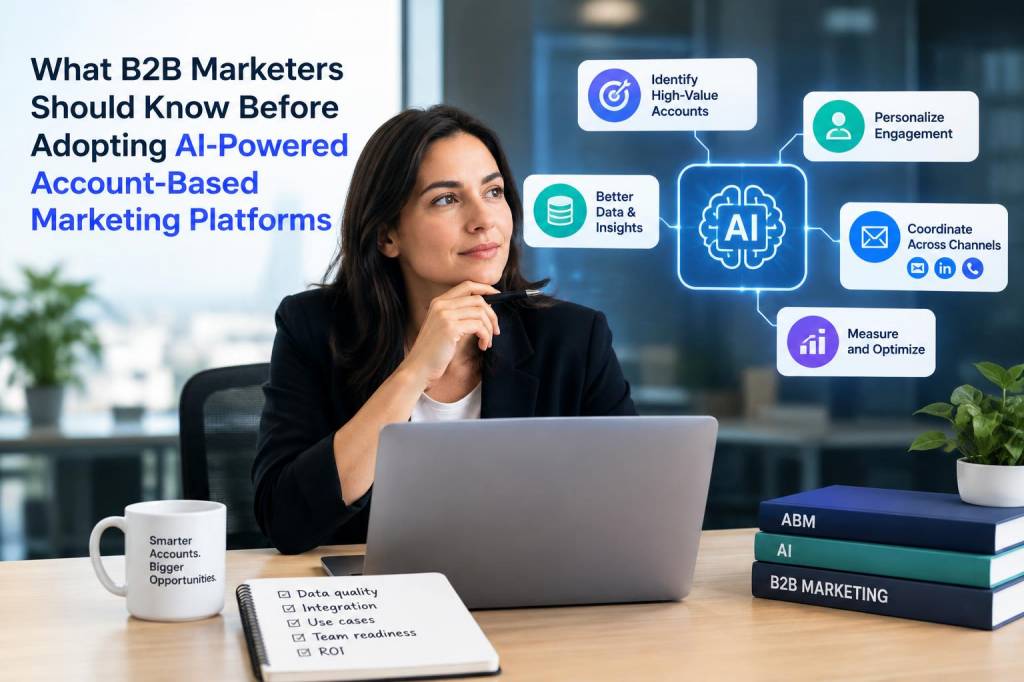
When I started exploring AI-powered account-based marketing platforms, I felt the same mix of excitement and caution that many B2B marketers feel today. The promise is attractive: better account selection, sharper personalization, faster execution, and clearer revenue impact. But I have learned that these platforms are not magic. They work well only when they are built on strong strategy, clean data, and realistic expectations.
Before I adopt any AI-driven ABM system, I ask myself a simple question: will this platform help me make better decisions, or will it simply automate weak ones? That question shapes everything else. AI can amplify strong marketing, but it can also magnify bad inputs, poor alignment, and unclear goals.
Start with a clear ABM strategy, not with software
One of the biggest mistakes I see is buying a platform before defining the account-based marketing motion. I have done enough marketing work to know that technology should support strategy, not replace it. If I do not know which accounts matter most, what stage each account is in, or what success looks like, even the smartest AI cannot help me.
Before I compare vendors, I define:
- Which account tiers I want to target
- What ideal customer profile signals matter most
- Which teams own account selection, outreach, and reporting
- What “good” looks like in terms of pipeline and revenue
- How much personalization I can realistically support
Without that clarity, AI becomes a nice dashboard with no direction. I want a platform that strengthens my ABM strategy, not one that forces me to invent one after purchase.
Data quality matters more than model promises
AI-powered platforms depend on data, and that is where many teams struggle. I have seen impressive demonstrations built on weak data foundations. Once the platform is connected to a fragmented CRM, outdated contact records, or inconsistent firmographic fields, the output becomes unreliable very quickly.
Before adoption, I look carefully at the quality of my account and contact data. I ask whether our CRM is clean, whether enrichment sources are trustworthy, and whether our historical performance data is complete enough for meaningful predictions. If the data is messy, AI may still produce recommendations, but I would not trust them without validation.
I also pay attention to data freshness. B2B accounts change fast. Leadership moves, buying committees shift, budgets disappear, and intent signals expire. A platform that relies on stale data can create false confidence. I prefer fewer signals I can trust over a larger volume of questionable predictions.
Check whether the platform fits your revenue motion
Not every AI ABM platform fits every organization. A company with a long enterprise sales cycle needs something very different from a mid-market team focused on high-volume named accounts. I always look at the sales motion first.
If my team runs highly personalized outreach to a small set of strategic accounts, I need deep account intelligence, strong workflow support, and good collaboration tools. If I manage a broader ABM program, I may need better segmentation, scalable content activation, and automated prioritization.
I also consider how the platform aligns with sales development, demand generation, and customer marketing. A tool may look powerful in isolation, but if it does not support my actual process from first signal to closed deal, it creates friction instead of value.
AI is only useful when people understand what it is doing
I am careful around “black box” automation. If a platform tells me which accounts to target but cannot explain why, I hesitate. I want transparency. I want to know whether the recommendation came from intent signals, engagement history, firmographics, technographics, or predictive scoring.
That does not mean I need to understand every technical detail. It does mean I need enough visibility to trust the output and explain it to my team. When a sales leader asks why an account was prioritized, I should be able to answer with confidence.
This matters even more when AI suggests next-best actions or messaging angles. If I cannot see the logic behind those recommendations, I risk sending outreach that feels generic or misaligned. I prefer platforms that help me learn, not just obey.
Personalization still needs human judgment
AI can help me scale personalization, but it should never remove human judgment from the process. The best ABM programs I have seen still depend on thoughtful marketers who understand the account, the market, and the buyer’s context.
I use AI to surface patterns and accelerate production, but I still review the final message, the campaign angle, and the account fit. For example, a platform may identify that a target company has shown interest in a topic, but I still need to decide whether that interest is relevant enough to justify outreach.
I think of AI as a very capable assistant, not as the strategist. It can draft, rank, summarize, and predict. It cannot fully understand nuance, politics, timing, or the reality inside a buying committee. That is still my job.
Integration with existing systems is not optional
A platform can look fantastic in a demo and still fail in practice if it does not connect smoothly with the tools I already use. I need to know how it fits with CRM, marketing automation, sales engagement, analytics, ad platforms, and data enrichment tools.
If my team has to jump between systems constantly, adoption drops fast. I also worry about duplicated records, inconsistent reporting, and manual work that defeats the purpose of AI in the first place. I want a platform that reduces operational load, not one that adds another silo.
When I evaluate integration, I look at:
- Native CRM sync quality
- Ease of importing and exporting account data
- Compatibility with sales workflows
- Reporting consistency across tools
- API access for custom use cases
Strong integrations turn AI from a disconnected feature into an active part of the revenue engine.
Measurement must go beyond vanity metrics
AI-powered ABM platforms often produce attractive activity reports. I can see account engagement, content interactions, score changes, and campaign reach. But those numbers only matter if they connect to revenue outcomes.
Before adoption, I define the metrics that really matter to my business. That usually includes account progression, sales acceptance, pipeline creation, opportunity velocity, deal size, and influenced revenue. I do not want to celebrate engagement if the accounts never move forward.
I also make sure the platform supports meaningful comparison. If I cannot separate AI-assisted activity from baseline performance, I will struggle to prove value. I want to know whether the platform is improving account quality, shortening sales cycles, or increasing conversion rates.
| Evaluation area | What I check | Why it matters |
|---|---|---|
| Data quality | CRM accuracy, freshness, enrichment coverage | Poor data weakens recommendations |
| Transparency | Reasoning behind scores and recommendations | I need trust and explainability |
| Integration | CRM, automation, sales, and analytics fit | Workflow adoption depends on connection |
| Measurement | Pipeline, velocity, revenue, and account progression | Activity alone is not enough |
| Governance | Privacy, permissions, and usage controls | Risk management matters |
Privacy, compliance, and brand safety deserve attention early
AI platforms can create real risk if I ignore compliance and governance. I need to know where the platform sources its data, how it handles consent, and whether it respects regional privacy rules. If I work across multiple markets, this becomes even more important.
I also pay attention to brand safety. Some platforms can automate outreach or content placement in ways that do not always reflect my company’s positioning. I want control over tone, audience, and exclusions. If the system makes it too easy to move fast without safeguards, I may create short-term efficiency at the expense of trust.
For me, governance is not a final checkpoint. It is part of the adoption decision from day one.
Team readiness is as important as platform capability
I have seen teams buy sophisticated tools and then underuse them because nobody had time, training, or confidence to operate them well. AI adoption is not only a software decision. It is a change management issue.
Before I commit, I ask whether my team can support the platform properly. Do we have someone who owns it? Can sales use the insights without extra friction? Are marketers trained to interpret the outputs? Is leadership willing to adjust process if the tool reveals better ways of working?
I also think about cultural readiness. Some teams embrace automation immediately. Others need proof, patience, and clear examples. If I push too hard too fast, I may face resistance. If I move too slowly, I miss the opportunity. The right pace depends on the team.
Vendor evaluation should feel practical, not theatrical
When I speak with vendors, I try to stay focused on real use cases instead of polished narratives. I ask to see the platform solve problems that resemble mine. I want live examples, not only marketing language.
Useful questions usually include:
- Which data sources power the account recommendations?
- How does the system adapt when buying signals change?
- What level of customization is available for scoring and segmentation?
- How does the platform support sales and marketing collaboration?
- What proof exists that it improves revenue outcomes?
I also ask about onboarding, support, and roadmap priorities. A platform may be strong today, but I want to know whether the vendor is investing in capabilities that matter to my future needs.
Adoption should begin with a narrow, measurable use case
When I finally adopt an AI-powered ABM platform, I avoid trying to do everything at once. I start with one clear use case, such as account prioritization for a specific segment, personalized outreach for a high-value tier, or account insight delivery for one sales team.
A narrow start helps me learn faster. I can test whether the data is reliable, whether users trust the outputs, and whether the platform creates measurable improvement. If it works, I expand. If it does not, I adjust before scaling the damage.
That approach has saved me from overcommitting to features that looked exciting but were not ready for daily use. It also helps me build internal confidence through evidence instead of hype.
In practice, the right AI-powered ABM platform should feel like a disciplined partner: one that sharpens my focus, strengthens my decisions, and helps my team spend more time on meaningful account work. When I evaluate it with that mindset, I make better choices and avoid being distracted by automation alone.