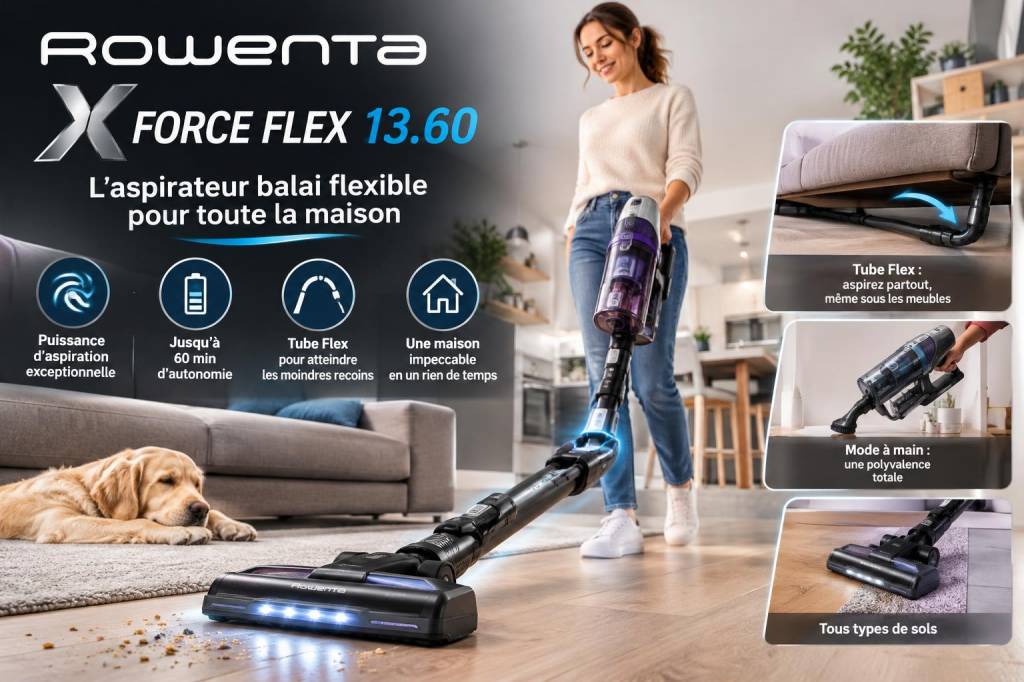
I look at a stick vacuum through a simple lens: can it make everyday cleaning feel lighter, faster, and less disruptive? That is exactly why the Rowenta X-Force Flex 13.60 stands out in my view. It is built around a clear promise: reach more places, switch between floor types with less friction, and reduce the small annoyances that usually make cleaning feel like a chore. If you want a deeper product-level overview, I recommend reading this aspirateur balai flexible pour toute la maison review alongside this article, because it matches closely with what I care about here: real usefulness in a home setting.
From a trends perspective, this model reflects a larger shift in household cleaning: buyers now want equipment that saves time, reduces effort, and adapts to mixed surfaces without needing a heavy upright machine. In many homes, one room has hard floors, another has rugs, and another collects dust in corners, under sofas, or around stairs. A modern stick vacuum has to handle all of that without turning into a compromise.
What I notice first about its design
The most important feature is obvious as soon as you see it: the flexible tube concept. For me, this is not a gimmick. It changes the posture of cleaning. Instead of bending low to reach under furniture, I can keep a more natural stance and let the vacuum bend into awkward zones. That matters if you clean often, if you have back sensitivity, or if you simply dislike the repeated crouching that traditional tools demand.
I also value the lightweight format. In a home with stairs, multiple rooms, or different levels, weight becomes a real business metric in household terms: if a tool feels burdensome, usage drops. A vacuum can have strong suction on paper, but if I hesitate to pick it up for five minutes of cleanup, it loses practical value. Rowenta’s approach feels designed for frequent, short sessions as much as for full-home passes.
Why flexibility changes everyday cleaning
Flexibility is not only about comfort. It affects coverage, speed, and consistency. I find three situations especially relevant:
- Cleaning under low furniture without moving every piece first
- Reaching baseboards, corners, and awkward zones near legs and frames
- Maintaining speed when shifting from open floor areas to tighter spaces
In many homes, dust does not settle evenly. It collects in edges, along skirting, and beneath furniture where standard heads struggle. A flexible stick vacuum reduces missed areas, which means fewer secondary passes. That is a real productivity gain, and I think that is why this category has become so popular.
Performance matters more than marketing language
When I evaluate a vacuum, I want practical evidence, not vague claims. Rowenta positions the X-Force Flex 13.60 as a versatile household tool, and that claim makes sense when I consider how these devices are usually tested. In independent benchmarks, cordless stick vacuums are often judged on suction consistency, edge pickup, maneuverability, battery endurance, and attachment usefulness. Those are the criteria I care about too.
For context, consumer testing outlets regularly emphasize battery runtime and debris pickup on mixed surfaces. For example, Wirecutter’s vacuum evaluations focus on floor performance and usability across rooms, while Consumer Reports measures carpet cleaning, bare-floor pickup, and pet-hair handling. I pay attention to those categories because they mirror actual home behavior rather than lab-only fantasy.
According to manufacturer data and retailer specifications commonly associated with this model, the X-Force Flex family is designed for up to around 60 minutes of runtime in eco-oriented usage conditions, with more demanding power modes naturally reducing that figure. In practice, that kind of range can cover a medium-sized home cleaning routine, provided I use power intelligently and avoid staying in high-boost mode longer than necessary.
Accessory strategy is a major part of value
One of the strongest reasons I consider a cordless vacuum “whole-home ready” is accessory quality. A machine is only as useful as its attachments when cleaning moves beyond open floors. The Rowenta X-Force Flex 13.60 makes sense as a household system because accessories expand what I can do with it.
Common accessory use cases include:
- Motorized brush heads for carpets and rugs
- Soft or parquet-focused tools for delicate hard floors
- Crevice tools for gaps, car interiors, and radiator edges
- Mini-brush tools for upholstery, stairs, and fabric surfaces
I particularly appreciate a setup that does not force me to switch to a different appliance for each room. In marketing terms, this is about reducing “friction” in the user journey. In home terms, it means fewer interruptions and a better chance that I actually finish a cleaning session in one pass.
Where a flexible stick vacuum earns its place
I see the Rowenta X-Force Flex 13.60 as especially strong in homes where cleaning needs vary from day to day. That includes apartments with limited storage, family homes with mixed floors, and spaces where quick daily pickups matter more than deep weekly rituals.
It also fits homes with these conditions:
- Frequent dust buildup under sofas and beds
- Mixed surfaces, including tile, wood, laminate, and low-pile rugs
- Small children, pets, or high daily foot traffic
- Limited tolerance for heavy or noisy equipment
I would not frame it as a replacement for every full-size vacuum in every scenario. Very large homes with thick wall-to-wall carpeting may still benefit from a dedicated plug-in machine. But for a broad share of households, a flexible cordless stick vacuum offers a strong balance of speed, reach, and convenience.
A practical comparison table
| Criteria | What I value | Why it matters at home |
|---|---|---|
| Flexibility | Bends into low zones without much effort | Less bending, better access under furniture |
| Weight | Easy to carry room to room | Better for stairs and frequent use |
| Accessories | Useful tools for corners, fabric, and gaps | One machine can cover more tasks |
| Battery behavior | Enough runtime for regular home sessions | Cleaner routines with fewer charging breaks |
| Surface adaptation | Moves between hard floors and rugs smoothly | More consistent results across rooms |
What I would verify before buying
Even when a model looks excellent on paper, I always check a few ownership details. Those details can change satisfaction more than raw power claims.
- Battery replacement policy: I want to know whether replacement is simple and affordable.
- Filter maintenance: I prefer systems that are easy to clean without special tools.
- Dustbin capacity: I care about how often I need to empty it in a normal week.
- Noise level: A quieter machine feels less intrusive during evening cleaning.
- Storage setup: Wall docking or compact storage can improve daily habit formation.
These points matter because a vacuum is not only a purchase; it becomes part of a household workflow. If storage is annoying or maintenance feels messy, the device gradually loses value even if performance remains good.
What external sources tell me about this category
I like to validate product impressions against credible sources rather than rely on brand language alone. For cordless vacuums, I regularly look at testing and buying advice from Consumer Reports, Wirecutter, and RTINGS. Their methodologies vary, but they consistently reinforce a few themes: real cleaning power matters, maneuverability matters, and battery reality matters more than headline claims.
I also pay attention to market trend reporting from retailers and category analysts because cordless vacuums continue to gain share in home-cleaning spending. In plain language, people are choosing convenience. That trend supports products like the X-Force Flex line, which tries to combine accessibility with enough performance to cover a whole routine rather than a single room.
Source signals I would keep in mind
- Consumer Reports vacuum category
- Wirecutter cordless stick vacuum coverage
- RTINGS cordless stick vacuum rankings
FAQ-style answers I would expect readers to ask
Is this type of vacuum really suitable for a full home? In many cases, yes, especially if your floors mix hard surfaces and low- to medium-pile rugs. I see it as a very strong daily-use tool.
Does flexibility matter enough to change the experience? Yes. I consider it one of the most meaningful ergonomic upgrades in this category because it reduces bending and improves access.
Is accessory variety just a marketing trick? Not if the tools are genuinely useful. A good crevice tool, upholstery tool, or mini motorized brush can change what I can clean without switching machines.
How do I judge cordless value? I compare runtime, maintenance, weight, accessory relevance, and how often I would actually use it. Real value comes from daily convenience, not only from specifications.